AIMS

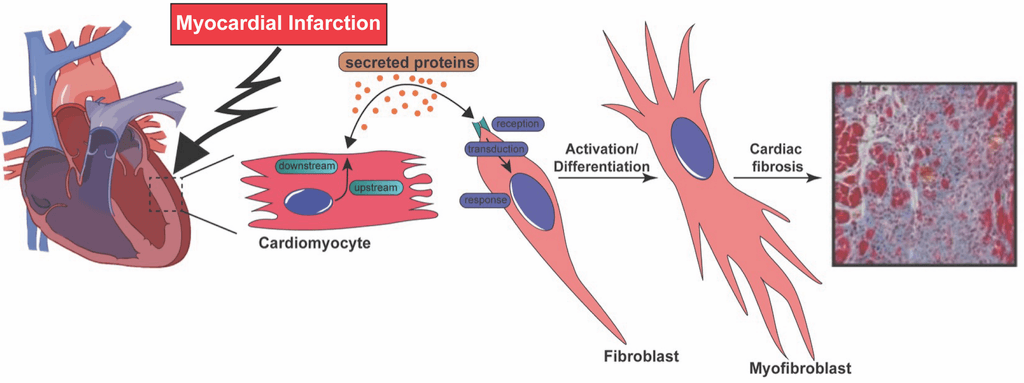
This project investigates the hypothesis that factors secreted by cardiomyocytes (cardiocrines) shape cardiac remodeling after myocardial infarction. Specifically, we plan to 1) identify the receptors and downstream pathways of fibroblasts after cardiocrine-activation; 2) characterize central transcriptional regulators of hypoxia-induced cardiocrines; and 3) resolve the spatial heterogeneity of cardiocrine signaling in the infarcted heart. Joint secretome analyses of cardiomyocytes with various subprojects illustrate a central anchoring within the CRC.
B06 2nd period - Cardiocrine signaling as a regulator of cardiac homeostasis and fibrosis

Findings: 1st funding period

After a heart attack, scar tissue builds up in the heart, which can impair its function over time. Our research group studies how heart muscle cells “talk” to the scar-forming cells through messenger signals, hoping to find ways to slow or prevent adverse remolding and preserve cardiac function.

In the last funding period, we focused on relevant messengers, which appear to promote or reduce scarring and found examples and possible target proteins for both sides – proteins secreted from cardiomyocytes with a pro- or anti-fibrotic functions. Blocking a pro-fibrotic candidate after a heart attack in mice reduced the production of scar-forming proteins. Treated mice ended up with less scarring and better heart pumping function. In contrast to this, when heart muscle cells produced less of a specific anti-fibrotic protein, scarring signals increased.

To study this in detail, we developed a minimally invasive mouse model of heart attack that mimics the common clinical situation where blocked vessels are reopened by heart catheterization. We found that receptors for the anti-fibrotic candidate become highly active in the days after a heart attack in mice. Overall, these findings suggest that the deeper exploration of cardiocrine signaling has the potential to reveal new treatment options for patients after a heart attack.

SELECTED SCIENTIFIC OUTCOMES

2025

Sicklinger F, Hartmann N, Kovacs A, Weinheimer C, Nigro J, Thiemann T, Amrute J, Schumacher D, Kornardt M, Wienecke LM, Rompel L, Fischer J, Bachman J, Bedard O, Das S, Kuhn TC, Völkers M, Brandes RP, Kramann R, Rosenthal N, Frey N, Lavine KJ, Leuschner F.

Circ Res. 136:1099–1109, 2025.

2024

Cordero J, Elsherbiny A, Wang Y, Jürgensen L, Constanty F, Guenther S, Boerries M, Heineke J, Beisaw A, Leuschner F, Hassel D, Dobreva G.

Nucleic Acids Res. 52:4215-33, 2024.

2024

Wünnemann F, Sicklinger F, Bestak K, Nimo J, Thiemann T, Amrute J, Nordbeck M, Hartmann N, IbarraArellano MA, Tanevski J, Heine C, Frey N, Lavine KJ, Coscia F, Saez-Rodriguez J, Leuschner F, Schapiro D.

bioRxiv. 2024:2024.05.20.594955.

Scientific Staff

© UKHD

Anita Kumari
Alessandra Isasi Nalvarte
Tim Kuhn
Tobias Thiemann
Niklas Hartmann
Celina Kley
Lennart Rompel